By Staff
Success often arrives wrapped in applause—new titles, broader visibility, increased influence. But beneath the external markers of achievement, something quieter is often happening. In this conversation, Deondriea invites us to examine the unseen cost of upward mobility: the subtle erosion of self-trust that can occur as we learn to survive, adapt, and perform within systems that reward polish over presence. What emerges is a powerful reframing of confidence—not as volume or bravado, but as an internal anchoring that too many high-achievers unknowingly abandon along the way. This is an exploration of what we lose, why it happens, and how reclaiming confidence may be the most meaningful promotion of all.
You work with people who are actively climbing—careers, leadership, visibility. What do they tend to lose internally as their external success grows?
As people climb, they rarely lose ability or ambition; they lose permission. Permission to trust their instincts without second-guessing, to speak without softening, and to want more without explaining why.
The higher they go, the more they’re rewarded for being palatable, composed, and agreeable. Over time, they start outsourcing their inner authority. They read the room before they read themselves, choosing what’s acceptable over what’s true. And because the wins keep coming, the tradeoff goes unquestioned.
What many professionals lose internally is self-trust. Not all at once—but quietly. It shows up as overpreparing for rooms they already belong in. Editing their voice to avoid being labeled “too much.” Confusing exhaustion with impact and silence with maturity. From the outside, it looks like confidence. From the inside, it feels like fragmentation.
That’s the paradox of success no one warns you about: you can be rising and slowly disappearing at the same time. And the real work isn’t climbing higher—it’s learning how to rise without leaving yourself behind.
Many readers believe confidence grows with experience. Why does confidence so often decline as responsibility and recognition increase?
Experience doesn’t just teach skill—it teaches consequences. As responsibility and recognition increase, so does scrutiny. The margin for error narrows. The stakes get higher. And suddenly, confidence is no longer rewarded for being authentic; it’s rewarded for being controlled, calculated, and correct.
Many professionals stop asking, What do I know? and start asking, How will this be received? They don’t lose confidence because they’re less capable. They lose it because they’re more visible.
With experience comes exposure to politics, expectations, and unspoken rules. You learn which parts of you are praised, which are tolerated, and which are quietly penalized. Over time, confidence becomes conditional—it works as long as you stay within the lines.
Confidence declines not from lack of competence, but from over-correction. From constantly managing perception instead of honoring intuition. From carrying the weight of being “the example,” “the first,” or “the dependable one.”
The irony is this: the more trusted you become externally, the more you’re tempted to distrust yourself internally. Unless that tension is named, success doesn’t strengthen confidence—it teaches you how to perform it.

You describe confidence loss as quiet and cumulative. What are the earliest signs someone’s confidence is eroding for approval or safety?
The earliest sign is self-editing. It’s the moment you know what you want to say and pause to calculate. You start scanning faces before trusting your own knowing. You soften language, minimize ideas, and pre-emptively manage other people’s comfort to protect your own standing.
Another early signal is when approval starts to feel like oxygen. You feel relief when you’re validated and disproportionate weight when you’re not. Your confidence becomes something you borrow from the room instead of something you carry into it.
Then there’s the shift from choice to compliance. You say yes faster than you check in with yourself. You override your instincts because “this is how it works here.” You call it professionalism or strategy, but your body knows it as tension.
Confidence doesn’t collapse loudly. It erodes through small, repeated concessions. Each time you abandon your truth for approval, your nervous system learns that safety lives outside of you. The moment you notice those negotiations, you regain the power to choose yourself again.
You’ve introduced the concept of Profliction™—the idea that professional success can wound. How does this show up specifically during upward mobility?
Profliction™ is the hidden, chronic injury caused by professional experiences that erode confidence, self-worth, and belonging. It shows up when success requires self-betrayal disguised as growth.
As people rise, the rules change. Feedback becomes subtle. Expectations go unspoken. Authenticity narrows while performance expands. Because the promotion looks like progress, the harm goes unnamed—and that’s where Profliction takes hold.
You start proving instead of belonging. You anticipate bias and adjust in advance—your tone, posture, language, even ambition. Each adjustment feels strategic, but cumulatively it teaches your nervous system that success is conditional.
Upward mobility also increases isolation. You’re praised for resilience while absorbing microaggressions and impossible standards. From the outside, you look high-functioning. From the inside, you’re hyper-vigilant.
Profliction isn’t caused by failure. It’s the result of surviving success in systems that weren’t designed to hold you whole.
How do expectations—unspoken rules, gratitude narratives, cultural pressure—shape the way people edit themselves as they rise?
Expectations rarely tell you to shrink; they reward you when you do. Be grateful. Don’t rock the boat. Be impressive, but not threatening. Authentic, but only in familiar ways. And because access and safety are on the line, people quickly learn what gets applause and what creates friction.
You smooth your edges. Translate your truth. Downshift your presence so you’re not perceived as “too much” or “ungrateful.” What looks like emotional intelligence is often hyper-vigilance.
Gratitude narratives turn survival into silence. When you’re told you should feel lucky, discomfort feels like a flaw instead of data. Cultural pressure reinforces respectability, professionalism, and likability as the price of success.
Over time, self-editing becomes automatic. Each edit teaches you that parts of you are negotiable. And eventually, you don’t just change how you show up—you change what you believe you’re allowed to want.

What does it cost someone, long-term, to keep succeeding in environments that require them to minimize or mute parts of who they are?
It costs you internal authority. Your outer life expands while your inner life contracts. You become fluent in adaptation but estranged from your own knowing.
Decision-making becomes heavy. Your body stays on alert. Confidence depends on context. You’re productive but unsettled—accomplished yet detached from your own wins.
Self-silencing rewires your nervous system. Safety becomes approval, not alignment. Success turns into something you maintain instead of inhabit.
The ultimate cost isn’t burnout—that’s a symptom. The real cost is living a life where you’re visible everywhere except to yourself.
You challenge the idea that confidence is about being bolder or louder. What does grounded, embodied confidence actually look like at higher levels of leadership?
Grounded confidence is quietly immovable. It doesn’t rush to speak, but never hesitates when it does. It occupies space without posturing.
It shows up as internal alignment. Decisions come from discernment. Feedback is received without collapse. Silence is intentional, not protective. Presence replaces performance.
Embodied confidence tolerates discomfort—yours and others’—without shrinking. Loud confidence seeks validation. Grounded confidence creates gravity.
When confidence is embodied, leadership stops being projected and starts being transmitted. Your steadiness sets the tone.
How has your own journey up influenced the way you now protect your voice, boundaries, and sense of self?
Being the first—and often the only—taught me I didn’t need to prove my right to be there. Early on, I overprepared and outsourced safety to performance.
The shift came when I realized the room was responding to my presence before I spoke. So I stopped managing perception and started protecting my center.
Now, I don’t rush my voice. I honor internal signals as data. I refuse to contort myself to make others comfortable with my competence.
My confidence today isn’t performative. It’s anchored. The higher I’ve gone, the clearer it’s become: real confidence is not abandoning yourself in the space you already occupy.

For readers who recognize themselves in this story—who feel they’ve climbed far but drifted from themselves—what does reclaiming confidence begin with?
It begins with telling yourself the truth without judgment. Not the polished version, but the private one you edited to survive.
Confidence doesn’t return through force. It returns through permission—permission to pause, to listen, to stop calling self-betrayal strategy.
The first step is noticing where you stopped asking what you want and started asking what will work. That awareness alone begins restoring self-trust.
Reclaiming confidence isn’t about becoming someone new. It’s about remembering who you were before the edits, the armor, and the silence.
If there’s one truth this conversation leaves us with, it’s this: losing yourself on the way up is not the price of success—it’s a warning sign. Confidence was never meant to be performed or traded. It is the ground you stand on as you rise. When self-trust is restored, success stops feeling like something you survive—and starts feeling like something you truly get to live.
About
Deondriea Cantrice is a certified confidence coach, author, speaker, and anti-trafficking activist who helps people stop performing success and start living it.
Her work is for the high-functioning, highly capable, quietly exhausted—those who look accomplished on the outside but feel disconnected, unseen, or diminished on the inside. Deondriea doesn’t teach surface confidence or motivational hype. She helps people rebuild self-trust, reclaim their voice, and lead without self-erasure.
Through 1:1 coaching, group programs, and online courses, Deondriea challenges the unspoken rules that reward overachievement, silence, and self-abandonment. Her work sits at the intersection of leadership, identity, and power, naming what many professionals have been taught to normalize and giving them language, tools, and permission to choose themselves again.
Beyond coaching and authorship, Deondriea is a committed anti-trafficking activist and an active member of Sigma Gamma Rho Sorority, Inc., where service, advocacy, and leadership are lived values.
At the core of everything she does is a simple truth: success should not require self-betrayal. And confidence isn’t something you perform—it’s something you come home to.
Social Media
www.twitter.com/deondriea
Books
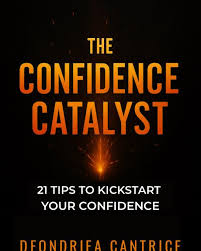
Confidence Catalyst: 21 Tips to Kickstart Your Confidence
About The Author