
By Staff
What first inspired your journey into photography and visual storytelling, and how has your artistic voice evolved over time?
Photography was actually in my blood long before I picked up a camera seriously. My grandfather was a photojournalist in Durham, North Carolina exposing the inequalities of segregated education during the civil rights era. He opened Stanback Studio in 1947, documenting Black community life. That legacy lived in the background of my creative life for decades while I pursued other things.
I began my art career in earnest as a painter and comic strip artist in the early 2000s, even briefly owning a gallery in Atlanta’s Castleberry Hill neighborhood. But it was the COVID pandemic that called me back to the camera in a serious way. Walking the quiet streets near my home in Decatur during those early lockdown months, I started documenting a city with images largely devoid of human presence. And those solitary walks grew into my BTNTRX (Beaten Tracks) project, an examination of how Atlanta’s railroad infrastructure has shaped the city’s racial, cultural, and economic geography. My first photo book, BTNTRX.V1: Beaten Tracks, came out of that work in 2021.
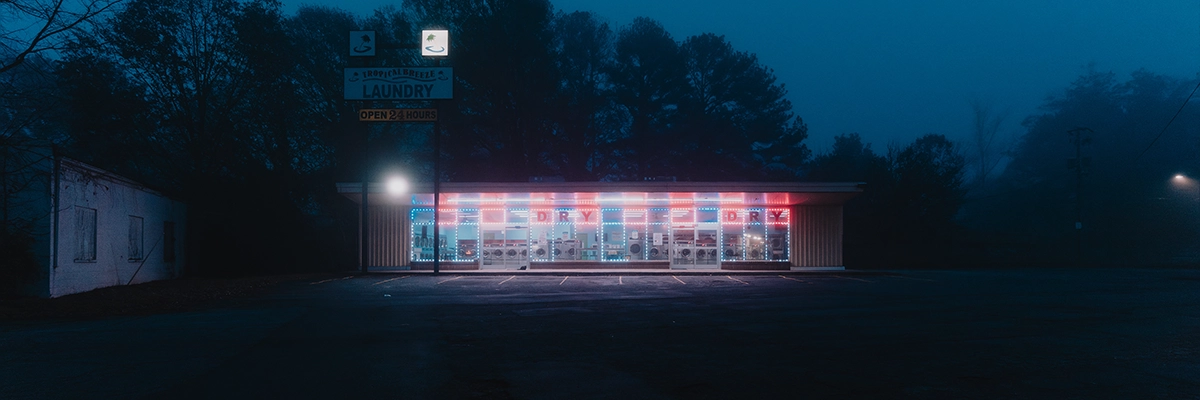
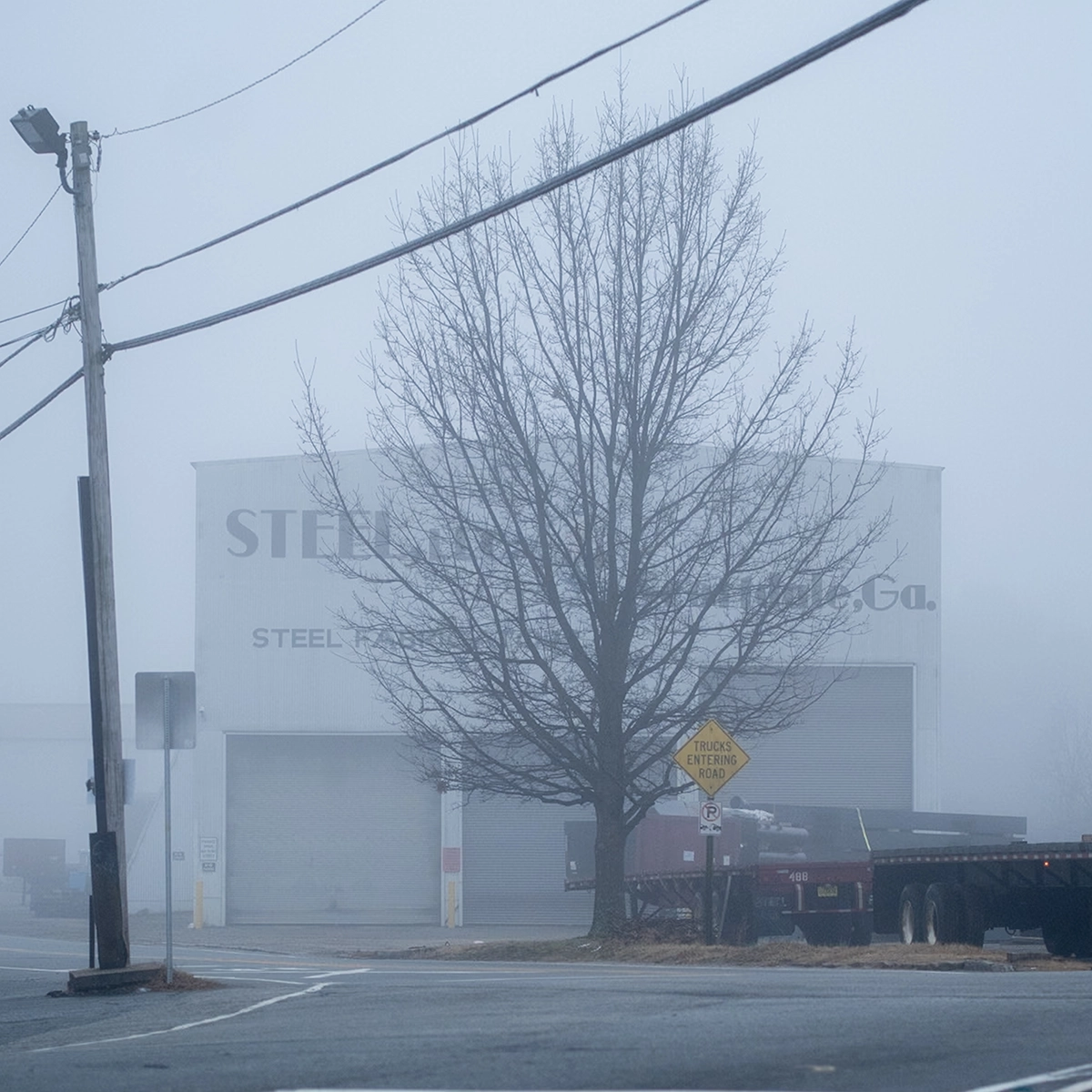
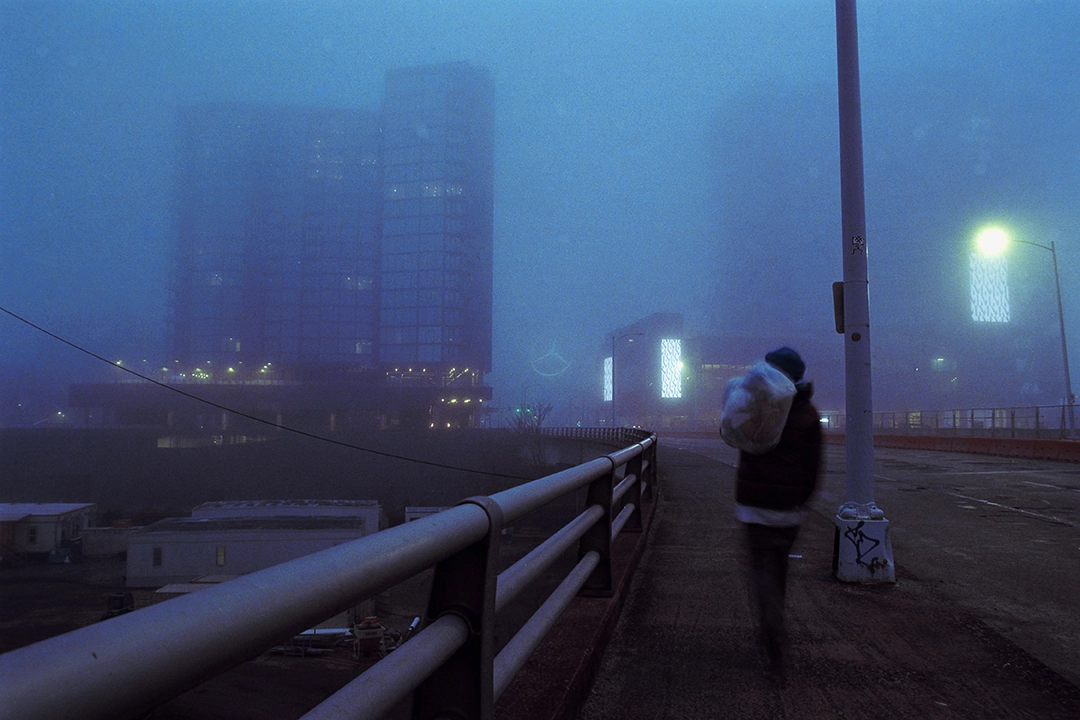
From there, my voice continued to evolve. I stopped painting entirely after my first photography exhibition sold out, and I’ve never looked back. Today, that voice is shaped by fifty years of living in Atlanta, from growing up on the Westside in the seventies and eighties, to watching the Eastside transform over the past two decades. The work has moved from pandemic documentation into something more deliberately atmospheric: shooting in fog, dusk, and storms to use natural conditions as a metaphor for the city’s constant, sometimes painful, reinvention.
Your work often captures emotion and identity in a powerful way. What do you hope people feel when they experience your art?
The comment I hear most often at exhibits, and the one that means the most to me, is some version of: “I know where that is! I’ve never noticed it like this.” That’s exactly what I’m after. Not just making familiar places look good, though I do love that part, but creating the conditions for someone to suddenly pay attention to something they’ve been moving past their entire lives without really seeing.
That applies to both bodies of work in different ways. With BTNTRX, the hope is that once you understand a railroad line as a tool of racial, cultural, and economic segregation you can’t drive past those tracks or visit the surrounding neighborhoods the same way again. The moment that clarified the whole project for me came during a shoot at the Scottdale Steel factory, when a man from the Clarendon Supermarket across the street approached me, sized me up, and eventually said: “I know what they think of me. I come from the wrong side of the tracks.” He wasn’t being metaphorical. He pointed to where he’d lived his whole life, the same side of those tracks where Black workers’ families had been placed when the Cotton Mills put white workers’ homes on the other side. That’s the kind of attention I want my work to activate in people and make the landscape suddenly legible.
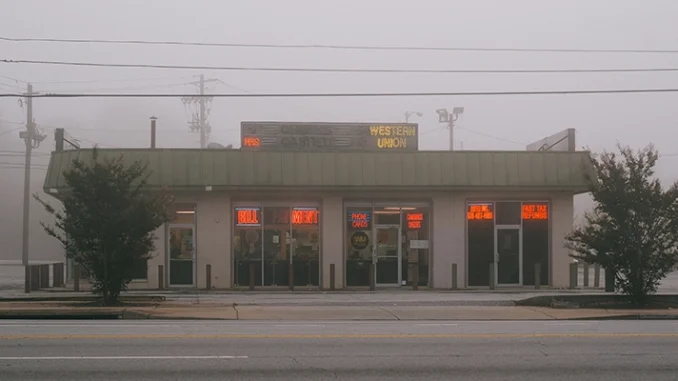
With Vanishing Point, the curiosity is more personal and more urgent. “Cash In Cash Out” is a check-cashing storefront I drove past for years before photographing it. For me, it surfaced vivid memories of my early adult life in the nineties paying bills, cashing checks, wiring money, all of it done in person at places exactly like that one. I want viewers to have their own version of that experience: the recognition of something familiar, followed immediately by the awareness that it might not be there much longer. Curiosity, then consequence.
As an artist, how do you balance creativity with the responsibility of authentically representing the people and stories you photograph?
I lean heavily on specificity and research as the foundation of authenticity. For the Vanishing Point series, every building I photograph gets researched. I want to understand who built it, what businesses operated there, what role it played in neighborhood identity, and what pressures are driving its transformation or disappearance. The photograph alone isn’t the whole story; the context is what makes the documentation responsible.
With the BTNTRX work, I’m also very conscious that I’m photographing infrastructure whose history is deeply racialized. Railroad lines used to enforce spatial segregation in Atlanta don’t just sit in the landscape neutrally. The responsibility there is to not aestheticize that history, but to make it legible. I grew up on the Westside and I’ve lived on the Eastside for over twenty years. I’m not an outsider looking in, and I think that accountability to place is part of what keeps the work honest.
I’m also careful about what I claim. I’d rather position something accurately as documentary work than overstate it as something more grand. The work is more powerful when it’s grounded.
How has your personal journey shaped the perspective you bring behind the camera?
In almost every way. I’ve lived in Atlanta most of my life. Born in 1971, I grew up on the Westside through high school, returned after graduating from the University of Miami in 1994, and I’ve watched this city transform through every phase of its modern evolution: the 1996 Olympics, the BeltLine, the gentrification waves that moved inward from the perimeter and outward from downtown simultaneously. That lived history isn’t background to the work, it is the work.
There’s also the thread of my grandfather’s legacy that I’ve come to understand more deeply as my own practice has matured. He used his camera to document what needed to be documented, to tell the truth about his community when the mainstream press wouldn’t. I think about that every time I point my lens at a block that’s about to change forever. I’m a computer engineer by training and spent three decades in technology and digital strategy before centering my creative practice, and that background actually informs how I think about systems, patterns, and the structural forces that shape communities. The camera is just the tool that makes those patterns visible.
In an era where imagery moves quickly across social media, what does meaningful and intentional artistry look like to you?
It looks like patience and a willingness to return to the same subject over and over until it shows you what it wants to be.
There’s a piece I’m exhibiting next month called “Strong Back Drink,” a Caribbean chicken and fish shop in Scottdale, not far from where the BTNTRX project began. I drive past it regularly, and I’ve made multiple attempts to photograph it, both digitally and on film, working through different compositions, different light, different conditions. I have so many images of that building that the version I’m showing may not be the last word on it. There may be more to release as I keep sitting with what I have.
“Cash In Cash Out” required months of the same kind of circling before the conditions aligned. I knew the building had something to offer; I just hadn’t found the right way in yet. When a foggy morning finally came, I knew immediately that was the day. That slow, deliberate attention to a subject you already have a relationship with is what intentional artistry looks like to me. The atmospheric conditions aren’t a trick. They’re what emerge when you’ve shown up enough times that the place starts to trust you.
Intentional artistry also means being honest about why you’re making an image. I’m not photographing Atlanta’s changing neighborhoods to chase a trend or garner engagement on social media. I’m doing it because I’ve watched these specific places my entire life and have something to say about what their transformation means. The intention has to be rooted in genuine relationship to the subject, not just visual fluency. And ultimately, the work should exist as something physical – a book, a print, something you hold and return to. Slowing people down enough to actually look is part of the artistic intention.
What challenges have you faced as a creative entrepreneur, and how have those experiences strengthened both your artistry and your purpose?
The honest answer is that having spent thirty years as a digital transformation strategist building technology platforms for companies like IBM, Cox, and Ting has made me very good at thinking systematically about creative projects, but it also meant I came to fine art with habits that don’t always serve the work. I’m wired to build infrastructure and optimize processes. Learning to stay in uncertainty, to wait for the decisive moment, to not rush a project because a timeline is inconvenient has been the real creative education.
Funding is the other persistent challenge. Fine art photography, particularly documentary work that isn’t easily commercial, requires you to build your own patronage. My first book sold a hundred copies to people who genuinely wanted it. It’s not a huge number, but they were the right hundred people. Learning to value that kind of limited, intentional reach over vanity metrics has made the work more focused.
What’s strengthened my purpose is realizing that my specific position as Black Atlantan, technology professional, photographer, and son of the South is actually rare in the spaces where I’m showing work. That specificity isn’t a liability to manage; it’s the reason the work is distinct.
Heart & Soul Magazine celebrates culture, resilience, and inspiration. How do those themes connect with your work and the legacy you hope to build?
The through-line in everything I do is the idea that communities carry more history than the built environment is allowed to show. Railroads in Atlanta didn’t just move freight, they drew the lines that determined who could live where, who had access to capital, whose neighborhood could be erased in the name of progress. The atmospheric images in Vanishing Point aren’t just aesthetically pleasing, they’re about the mood of a place that’s being transformed faster than it can be remembered.
The resilience is in the buildings themselves. The wing spot that’s still open on the corner despite every economic pressure to the contrary, the stable that survived being converted into lofts, the commercial strip that stayed Black-owned through decades of disinvestment. I want to leave a record that those things existed and mattered.
My grandfather’s legacy is part of this too. He ran Stanback Studio in Durham while simultaneously using photography to fight for civil rights. He understood that a camera could be both a business and a conscience. I think about that inheritance often – the idea that visual storytelling isn’t separate from social responsibility, it is social responsibility when you do it right. That’s the legacy I’m building toward.
Looking ahead, what projects, collaborations, or creative goals are you most excited to pursue, and what message would you like to leave with emerging artists?
The immediate horizon is busy in the best way. I have two pieces in a new exhibit inside, Be Kind ATL, a pop-up retail store opening downtown in time for the FIFA World Cup which feels right, since the city transforming for the global stage is exactly what my work is about. And on June 13th I’ll be participating in Artful ATL again, the one-night art party at Atlanta Contemporary that brings together emerging artists and collectors in a way that feels genuinely electric. Artists keep 100% of their sales, the energy is unmatched, and it’s become one of my favorite nights of the year.
On the book side, BTNTRX.V2: Shifting Lines releases June 1st documenting Atlanta’s expanded railroad network including the BeltLine and Centennial Yards, with cover art by Atlanta artist and illustrator Goldi Gold. BTNTRX.V3: Vanishing Point follows in Winter/Spring 2027, with cover art by Marryam Moma, the Tanzanian-Nigerian analog collage artist whose work is held in corporate collections at Microsoft, Google, and Starbucks, and whose creative practice I’ve been documenting for three years. Having her interpret my photography is something I’m genuinely moved by.
Beyond the releases, I want to continue building Lens & Letters as a space where the documentary process lives in public – not just the finished images, but the research, the false starts, the decision-making. That transparency matters to me.
For emerging artists: your specificity is your credential. The things that make your perspective particular – where you’re from, what you’ve witnessed, what’s been lost in your community – those aren’t things to smooth over in your artistic pursuits. They’re the reason your work is yours. Find the thing only you can document, and go document it seriously.
Social Media

About The Author