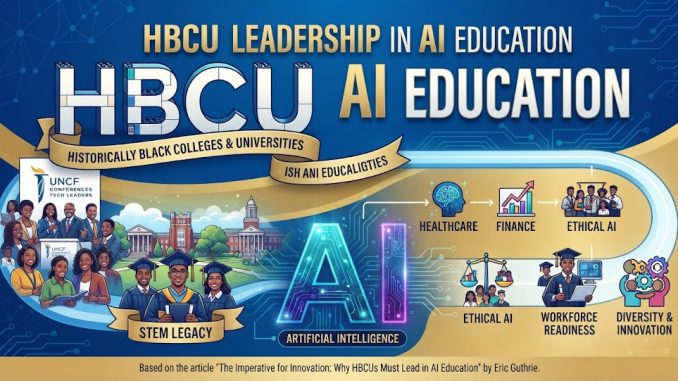

By Eric Guthrie
The Imperative for Innovation: Why HBCUs Must Lead in AI Education
Having recently returned from the very successful 2025 United Negro College Fund UNITE Conference in Atlanta, GA, where I met many impressive and distinguished HBCU leaders, I was inspired to write a series of articles on HBCUs and technology. There were a number of Artificial Intelligence presentations that discussed with this relatively new and groundbreaking technology.
As a graduate on Morehouse College, where I also sit on the National Alumni Board and as the Chairperson of the Board of Trustees for Barber-Scotia College, I can personally attest that Historically Black Colleges and Universities (HBCUs) have always stood as pillars of excellence, nurturing talent, fostering innovation, and driving social mobility within the Black community and beyond. The prior article I wrote addressed blockchain technology, as indicated by the title, this article will focus on Artificial Intelligence (AI).
AI is an Emerging Technology for the Future
The rapid ascent of Artificial Intelligence (AI) is undeniably reshaping industries, economies, and societies worldwide. From healthcare and finance to transportation and entertainment, AI’s transformative power is evident, creating new paradigms and an urgent demand for a skilled workforce. As covered in the 2026 UNITE conference, Historically Black Colleges and Universities (HBCUs) stand at a unique intersection of opportunity and responsibility.
By proactively integrating AI as a dedicated degree program, HBCUs can not only equip their students with future-proof skills but also champion diversity in a critical technological frontier, fulfilling their historic mission of empowering underserved communities and shaping an equitable future.
The current trajectory of the job market underscores the imperative for AI literacy. Roles like Machine Learning Engineer, Data Scientist, and AI Product Manager are consistently among the most sought-after and highest-paying positions. Companies across all sectors are seeking professionals who can design, implement, and manage AI solutions to drive innovation, enhance efficiency, and solve complex problems. For graduates entering this landscape, an AI degree is not merely an advantage; it is rapidly becoming a prerequisite for many high-growth careers! Failure to embrace AI education risks leaving HBCU graduates behind in the increasingly competitive global economy.
HBCUs Historic Success in STEM Education
HBCUs have a remarkable legacy of excelling in STEM education, often graduating a disproportionately high number of African American students in these fields despite representing a small percentage of higher education institutions. They provide nurturing, supportive environments that foster a strong sense of belonging and intellectual generosity, which are crucial for student success in rigorous disciplines. This intrinsic strength positions HBCUs to be ideal incubators for AI talent. While challenges such as funding disparities and access to cutting-edge resources exist, the opportunity to lead in AI presents a compelling case for strategic investment and partnership.
The impact of AI extends far beyond the tech industry, permeating diverse sectors in profound ways. In healthcare, AI is revolutionizing diagnostics, personalizing medicine, and streamlining operations. In finance, it powers fraud detection, risk management, and algorithmic trading. Retail leverages AI for predictive analytics, inventory optimization, and hyper-personalized customer experiences. Manufacturing benefits from AI in predictive maintenance and optimized production. Even agriculture is becoming more sustainable and productive through AI-driven precision farming. An AI degree program at an HBCU could be designed with interdisciplinary applications in mind, allowing students to specialize in AI for healthcare, finance, or social impact, thereby creating versatile graduates ready to tackle real-world challenges across various industries.
Perhaps the most compelling reason for HBCUs to prioritize AI education lies in the critical need for diversity in AI development. AI systems are only as unbiased and effective as the data they are trained on and the perspectives of the teams that create them. If AI is developed by a homogenous group, it risks perpetuating and even amplifying existing societal biases, leading to discriminatory outcomes in areas like facial recognition, credit scoring, and predictive policing. Research consistently demonstrates that diverse teams lead to more robust, accurate, and ethical AI systems because they bring varied problem-solving approaches, challenge assumptions, and identify potential biases that might otherwise be overlooked.
HBCUs are uniquely positioned to cultivate this much-needed diversity. By attracting and nurturing Black talent in AI, they can ensure that the voices, experiences, and perspectives of historically marginalized communities are embedded in the very fabric of future technologies. Graduates from HBCU AI programs would not only be technical experts but also ethically conscious leaders, equipped to advocate for fairness, transparency, and accountability in AI systems. This would be a powerful realization of the HBCU mission – to produce leaders who will uplift their communities and contribute to a more just society.
Establishing an AI degree program requires thoughtful planning and investment. This includes developing a comprehensive curriculum that covers core AI principles, machine learning, deep learning, natural language processing, computer vision, and the ethical implications of AI. It would also necessitate recruiting faculty with expertise in AI, investing in computational infrastructure (e.g., high-performance computing labs, cloud access), and fostering industry partnerships for internships, research opportunities, and career placement.
Fortunately, there are growing avenues for support. Federal agencies, private foundations, and tech companies are increasingly recognizing the importance of diverse AI talent pipelines and are offering grants and partnerships specifically aimed at strengthening AI education at HBCUs. Recent examples, such as the $9.1 million Mississippi AI Talent Accelerator Program involving several Mississippi HBCUs and National Science Foundation (NSF) ExpandAI grants awarded to institutions like Bowie State and Savannah State, demonstrate a burgeoning commitment to investing in AI capacity at these institutions. These opportunities can help bridge funding gaps and provide the necessary resources to launch and sustain robust AI programs.
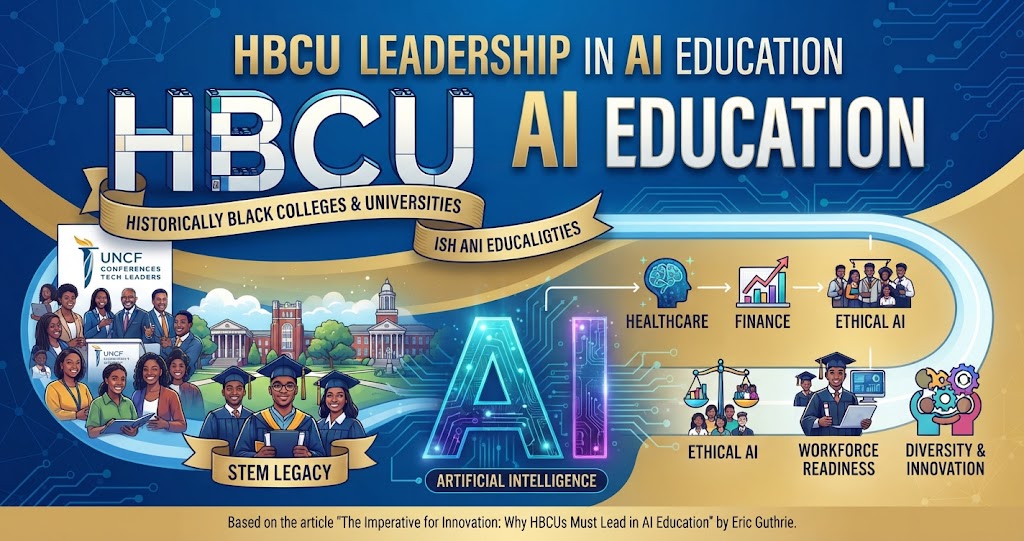
In conclusion, the decision for HBCUs to adopt Artificial Intelligence as a degree program is not merely about keeping pace with technological advancements; it is a strategic imperative rooted in economic opportunity, social justice, and institutional mission. By preparing a new generation of diverse AI professionals, HBCUs can empower their students to thrive in the careers of tomorrow, ensure that AI development is inclusive and ethical, and reaffirm their indispensable role in shaping a future where technology serves all of humanity equitably. The time for HBCUs to lead in the AI revolution is now.
About

Eric Guthrie, Esq.: Partner, The Cogent Law Group – Washington, D.C.; President & CEO, Better ME Better WE; Professor of Law; Author of Blockchain or Die Harder. (2026) Amazon #1 Bestseller and #1 New Release and Blockchain or Die (2019) Amazon #1 New Release, Amazon Seven Times #1 Best Seller.

About The Author